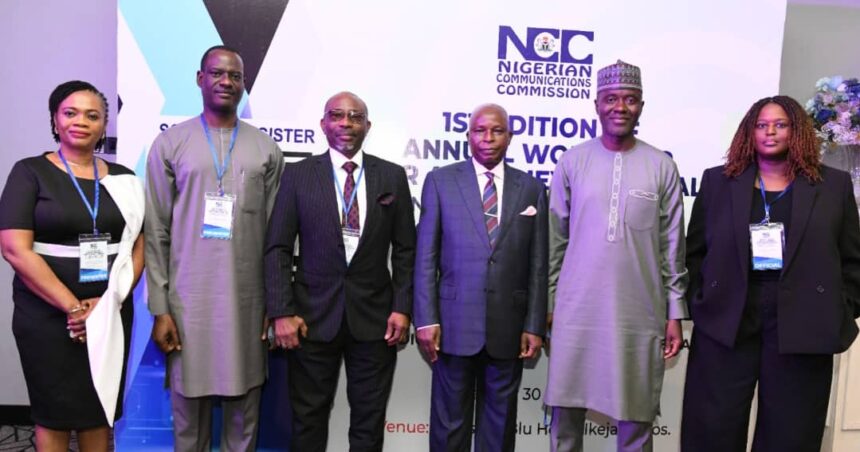
In an effort to build a bridge between the judiciary and the regulatory ecosystem driving Nigeria’s digital future, Nigeria’s telecommunications regulatory body, the Nigerian Communications Commission (NCC) has hosted the maiden edition of the its Annual Workshop for Attorneys-General in Lagos.
With its theme as “Building and Driving Synergy in Regulating Communications for the Digital Transformation of Nigeria”, the workshop is to fully unlock its potential of the communications sector, by tackling a range of challenges that cut across legal, regulatory, fiscal, and operational domains.
Speaking at the 3-day workshop that ends today, the Executive Vice Chairman and CEO of the NCC, Dr. Aminu Maida said the theme of the workshop reflects the Commission’s belief that collaboration is not optional, but essential. No sector, especially one as dynamic and impactful as communications, can be effectively regulated in isolation, he said.
The workshop was designed to address some of the most pressing issues in the sector today, including reflecting on the strengths of the Nigerian Communications Act (2003), its limitations, and areas for reform to ensure it remains fit for purpose in a rapidly evolving digital age; streamlining taxation in the communications sector; protecting Critical National Information Infrastructure (CNII); and addressing regulatory overlaps. “Fragmented oversight creates confusion and inefficiencies. Our goal is to explore reforms that enhance coordination and legal clarity across agencies,” the EVC explained.

Commending the NCC for its foresight in pulling together the Chief Law Officers of the Federation together to engage and exchange ideas on this platform, Attorney-General of the Federation & Minister Of Justice, Lateef O. Fagbemi noted that this is aimed at identifying and bridging knowledge gap with respect to regulatory frameworks, and strengthening mechanisms for regulating communications in Nigeria as a panacea for digital transformation.
Fagbemi acknowledged the critical need for Digital transformation towards improvement in socio-economic development of a nation. “A well regulated communications sector implies enacting and implementing laws and regulations that ensure protection of rights including right to privacy, data protection and consumer rights as well as regulations that support the ease of doing business in Nigeria,” he posited.
He tasked Attorneys-General, as Chief Law Officers under the constitution, to drive synergy using their unique positions to deliver on the vision of a transformed communications sector, for enhanced socio-economic development of the nation: “We must be able to advise our respective governments on policies that affect the digital economy, ensure that our laws and enforcement actions are constitutionally sound and support dispute resolution mechanisms that prevent prolonged litigation. We must also work to champion data privacy, cyber security and digital rights enforcement at the State level.”
I therefore wish to recommend that stakeholders work towards adopting strategies and mechanisms that enhance synergy in regulating communications for the digital transformation in Nigeria. These include legal and policy harmonization, creation of a Federal-State regulatory coordination forum, adopting uniform Right of Way (ROW) Policy Implementation, joint enforcement of laws that protect infrastructure and consolidation of digital taxation framework.”
Concluding the EVC further stressed on the need for collaboration in the telecommunications sector.
“As Nigeria accelerates its digital transformation, underpinned by technologies such as AI, IoT, and high-speed connectivity, the challenges will grow more complex. But so too will the opportunities. To succeed, we must adopt a Whole-of-Government approach that leverages the strengths of all institutions—federal and state.”