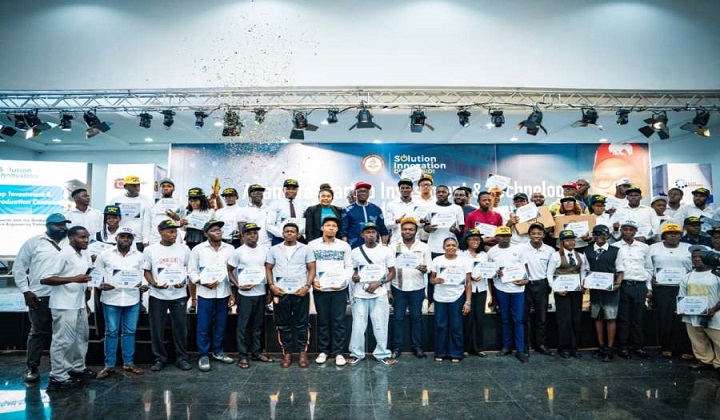
Anambra State, earlier this week, showcased the results of its ambitious drive to build a technology-powered economy, unveiling a new generation of digital professionals and startup founders as the cornerstone of its future growth strategy.
At the Anambra Startup Investment and Technology Skills Graduation Ceremony held at The Light House in Awka, the state celebrated the graduation of 400 newly certified technology professionals and the funding of 80 startups, underscoring a deliberate effort to position innovation, entrepreneurship and digital skills at the centre of economic development.
Convened by the Solution Innovation District (SID) on June 16, 2026, the event drew government officials, university representatives, private sector partners and members of the innovation ecosystem in what became both a celebration of achievement and a declaration of intent.
Addressing the gathering, Governor Prof. Chukwuma Charles Soludo described the occasion as more than the completion of a government programme. Rather, he said, it was proof that Anambra’s innovation ecosystem is beginning to deliver tangible results.

According to the governor, the state’s economic transformation agenda is anchored on developing world-class digital talent, nurturing indigenous enterprises and creating opportunities that enable young people to compete in the global knowledge economy.
The ceremony marked the graduation of three distinct but strategically connected programmes, each delivered under SID’s coordination and each representing a different layer of the state’s digital economy architecture.
The first was the Robotics Training Programme, delivered across eight cohorts in partnership with Circum Technologies under CEO Mr. Sylvester Uzoma.
Three hundred participants completed training in embedded systems, sensor programming, and industrial automation, a curriculum designed, in the words of SID CEO Chinwe Okoli, to ensure that the Fourth Industrial Revolution arrives in Anambra “not as a disruption but with our people among its creators.”
A deliberate subset of graduates was additionally trained as instructors, creating a train-the-trainer pipeline that extends the programme’s reach beyond its current cohort.
The second was the ISP Network Engineering Programme, a three-month technical curriculum developed with Connekt Broadband under the CEO, Mr. Ifeanyi Adirika.
One hundred participants completed a structured progression from virtual theory in Month One through laboratory practicals in Month Two to live field deployments in Month Three, covering MikroTik, Ubiquiti, and Cambium configuration, fibre splicing, OTDR testing, and real-world hybrid network design.
The third was the Anambra Startup Incubation Programme, through which 80 startups across three cohorts completed a 12-week process covering business model validation, customer discovery, financial planning, market testing, and investor readiness, each exiting with a Minimum Viable Product and, in several cases, early revenue or angel investment already secured.
Speaking at the ceremony, the Governor reiterated his administration’s commitment to transforming Anambra into Africa’s Silicon Valley.
This vision, he said, is driven not by politics, but by a clear and strategic imperative to secure the future of our state and its people.
In his words: “As the world evolves at an unprecedented pace, we must ensure that our young people are equipped with the skills and opportunities needed to thrive in the digital age.
“Through transformative initiatives such as the Solution Innovation District (SID) and the 1 Million Anambra Digital Tribe, we are building a strong foundation for a technology-driven and globally competitive economy.
“I congratulate all the graduates, including those trained in robotics and ISP network engineering, for their dedication and achievement. I also commend our partners and sponsors for their invaluable contributions to strengthening Anambra’s innovation ecosystem.
“Anambra is steadily emerging as a leading destination for technology, innovation, and digital enterprise. We remain committed to sustaining this momentum and creating opportunities for future generations. May Anambra continue to win.”
The event’s significance is not simply in the number of graduates but in the design philosophy running through all three programmes: the deliberate avoidance of training for its own sake.
ISP graduates are not entering a skills directory awaiting placement. They are being positioned as the last-mile deployment workforce for Anambra’s ongoing 2,000-kilometre statewide fibre rollout, the engineers who will take connectivity from backbone infrastructure into homes, schools, and communities that have never had reliable internet access.
“The engineers who will complete that last-mile connection are no longer being imported from other states,” Okoli said. “They are members of the Anambra Digital Tribe, trained here at SID.”