… They Should Also Issue Fraud Alerts To Customers
By CHIDIEBERE NWANKWO
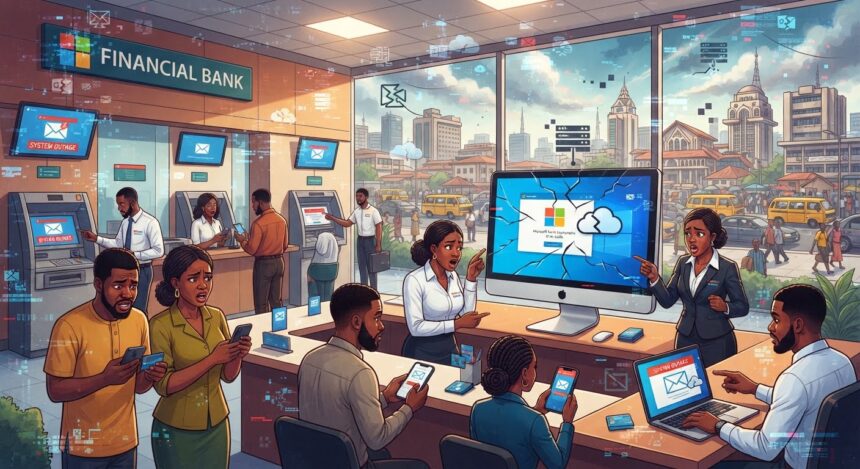
Financial Institutions in Nigeria have quickly turned to alternative channels to mask the effect of the recent Microsoft service disruption.
A widespread global Microsoft outage on November 12–13, 2026, knocked out email, chat, and workplace tools like Outlook, Teams, Copilot, and Microsoft 365 for millions of users across more than 70 countries, including Nigeria.

According to Microsoft, the failure was not a cyberattack, AI malfunction, or agent error, but was triggered by a network capacity and upgrade change that created a compounding feedback loop, delaying full restoration.
In a message sent to customers via its social media channels, EcoBank, the Pan African Bank, told its customers: “Dear Valued Customer, due to the ongoing Microsoft service outage, you may experience difficulty reaching us via email.” Listing phone numbers, the banks stated that customers can still reach them through the alternative phone channels.”
Also, in clarifying the extent of service restriction it is experiencing, Stanbic IBTC said: “Microsoft has reported a global Microsoft 365 service disruption affecting multiple services, including Microsoft 365 applications which form part of our service tools.
“As a result, responses to email enquiries are being delayed. However, this is not affecting our digital platforms, and you can continue to carry out transactions with your Stanbic IBTC cards and via our Mobile App, Internet Banking, ATM and POS.”
Although Microsoft issued a statement reported by the BBC noting that it was “deeply sorry” and working on a gradual, steady restoration of services, many institutions got full impact of the glitch.
In many of the countries affected, there were flight cancellations and delays hit airports; the Police departments faced trouble receiving online crime reports; courts experienced delays, and some local government services were paused; hospitals altered their communication methods, UK emergency and NHS services saw disruptions, and power grid operators temporarily resorted to fax machines, among other effects.
Whereas newer licensed digital banks, microfinance banks, and fintechs frequently run their daily operations on Google Workspace were not impacted by the glitch, legacy financial institutions such as Stanbic IBTC, Access Bank and FirstBank, rely on Microsoft 365 for email, Teams collaboration, and office software. Platforms like Moniepoint also build deeply on Google Cloud infrastructure.
However, some traditional banking groups adopt Hybrid Cloud ecosystems rather than relying on one vendor. For example, Ecobank partners with Google Cloud for AI, analytics, and digital banking services while maintaining enterprise productivity tools.
Corporate Nigeria, including top government institutions such as the Central Bank of Nigeria (CBN) bought into, and relies heavily on Microsoft infrastructure for daily operations due to the pioneering entrant of the software firm into the Nigerian market, and partly also to the efficiency and reliability of their solutions.
Financial institutions have been advised to take short, mid and long term measures to cushion the effect and forestall future breakdown of services in cases of Cloud service breakdown.
While financial institutions have activated alternative communication channels, while keeping core services running, handling high-priority settlements manually, they should also warn Customers About Phishing and “Vishing” fraud actions. They should issue public alerts warning that scammers will pose as bank staff or Microsoft tech support to exploit the confusion. They should also instruct staff and corporate clients to verbally verify any sudden changes to banking instructions or contact details through known, trusted phone numbers before releasing funds.
On long-term, financial institutions should audit single-point-of-failure dependencies on external cloud and communication providers, and practice offline incident response drills with staff.
Enterprise accounts can request billing credits or service level agreement (SLA) compensation through the Microsoft 365 Admin Center (or via their Cloud Solution Provider) before the claim window closes.
It will be recalled that the Central Bank of Nigeria (CBN) issued Circular PSS/DIR/PUB/CIR/001/004 on June 15, 2026, requiring all financial institutions and payment service providers to store and manage payment transaction data generated within Nigeria locally. The deadline for data localization compliance is January 1, 2027.