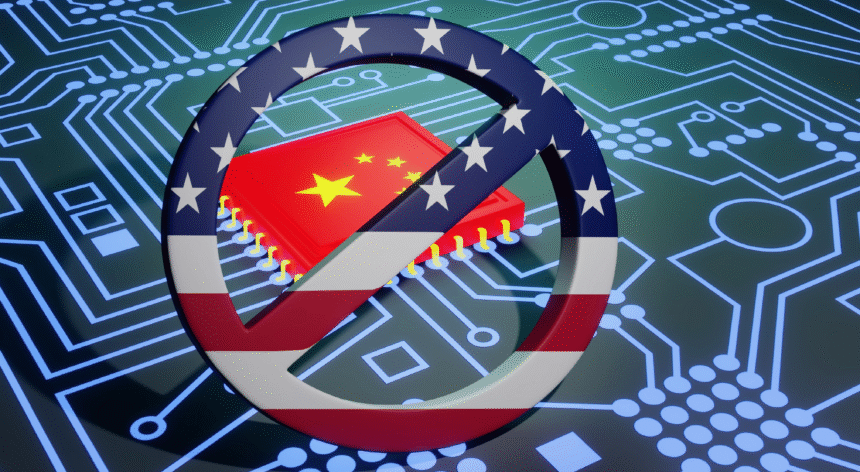
The United States has ordered a broad swathe of companies to stop shipping goods to China without a license and revoked licenses already granted to certain suppliers, said three people familiar with the matter.
The new restrictions, which are likely to escalate tensions with Beijing, appear aimed at choke points to prevent China from getting products necessary for key sectors, one of the people said.
Products affected include design software and chemicals for semiconductors, butane and ethane, machine tools, and aviation equipment, the people said.
Many companies received letters from the U.S. Department of Commerce over the last few days informing them of the new restrictions.

Firms that supply electronic design automation (EDA) software for semiconductors were sent letters last Friday that licenses would now be needed to ship to Chinese customers, two of the sources said.
The electronic design automation software makers include Cadence, Synopsys and Siemens EDA, one said.
The two sources said the Commerce Department will review requests for licenses to ship to China on a case-by-case basis, suggesting the action was not an outright ban.
It is unclear whether the new restrictions are part of a broader strategy to create leverage for trade talks during a pause in the imposition of higher tariffs.
The Commerce Department said it is reviewing exports of strategic significance to China, while noting “in some cases, Commerce has suspended existing export licenses or imposed additional license requirements while the review is pending.”
The White House did not immediately respond to a request for comment.
Shares of Cadence, which declined to comment, closed down 10.7% and shares of Synopsys fell 9.6%.
Synopsys’ CEO, Sassine Ghazi said in a call with analysts that the company had not received a letter nor had it heard from the Commerce Department’s Bureau of Industry and Security, which enforces export controls.
“We are aware of the reporting and speculations, but Synopsys has not received a notice from BIS … We have not received a letter,” Ghazi said.
Restricting Chinese firms’ access to EDA tools would be a big blow to the industry as Chinese chip design customers heavily rely on top-of-the-line U.S. software. In April, Chinese state news agency Xinhua said Synopsys, Cadence and Siemens’s Mentor Graphics together control more than 70% of the market share in China.
Chinese companies that have said they use Synopsys and Cadence software include design firm Brite Semiconductor, Zhuhai Jieli and semiconductor IP portfolio provider VeriSilicon.
VeriSilicon and Brite did not immediately respond to emails seeking comment. Calls to Zhuhai Jielei went unanswered.
However, three sources familiar with the matter in the EDA tools industry said on Thursday that business was still carrying on normally in China as companies awaited more clarification on how the restrictions need to be implemented.
“I believe this is another ineffective measure that will only help China advance its self-reliance, just like with semiconductors,” said Investment Director at Singapore-headquartered White Oak Capital Partners, Nori Chiou, adding that there are many pirated versions of these design tools, which are not hard to obtain.
Chiou said once legitimate channels are blocked, many Chinese EDA companies will benefit.
Domestic alternatives to the U.S. firms’ tools include Empyrean Technology and Primarius Technologies whose shares jumped 17% and 20% respectively. In 2023, Huawei said it had developed its own EDA tools for chip designs that can be produced at 14-nanometre or more advanced technology. It has been blocked from using U.S. suppliers since 2019. Any move to strip the software makers of their Chinese customers could deal a blow to their bottom.
“They are the true choke point,” said a former Commerce Department official, who added that rules restricting the export of EDA tools to China have been under consideration since the first Trump administration, but were ruled out as too aggressive.
Synopsys relies on China for about 16% of its annual revenue, and China accounts for about 12% of annual revenue for Cadence.
Synopsys, which partners with chip companies such as Nvidia, Qualcomm and Intel provides software and hardware used for designing advanced processors.
The Financial Times earlier reported that the Trump administration had ordered the software firms to stop selling their services to Chinese groups.
Similarly, U.S. Secretary of State, Marco Rubio announced on Wednesday, that the United States will start “aggressively” revoking visas of Chinese students, including those with connections to the Chinese Communist Party or studying in critical fields.
If applied to a broad segment of the hundreds of thousands of Chinese university students in the United States, the move could disrupt a major source of income for American schools and a crucial pipeline of talent for U.S. technology companies.