… Targets Energy Efficiency To Reduce AI Costs in Nigeria
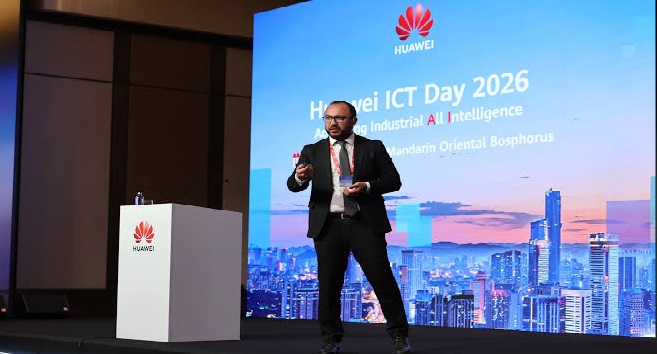
Huawei has showcased its latest artificial intelligence (AI) infrastructure, enterprise computing and data protection solutions at HUAWEI IT Day 2026, highlighting the growing role of advanced computing systems and AI-powered applications in transforming business operations and strengthening Local Resilience.
The event, themed “Empowering Nigeria’s AI Development Together: Compute, Collaborate, Create,” brought together 350+ customers and ecosystem partners.
Huawei and its partners showcased end-to-end computing infrastructure, from general-purpose to intelligent computing, along with partner AI applications built on Huawei platforms.

The event also highlighted practical approaches to Nigeria’s long-standing infrastructure and operating environment challenges, reinforcing Huawei’s commitment to sustainable local business operations.
Huawei Turkey R&D engineer, Furkan Elcelik, noted that in the Agentic AI era, CPU load will surge, shifting the CPU: GPU ratio from 1:N toward 1:1 and driving 500% CPU market growth within five years; ARM is set to reach 70% of the server market by 2030.
Huawei’s Kunpeng 950 (96 cores) leads competing vendors’ equivalent by 10%, and TaiShan 950 SuperPoD is the industry’s first general-purpose SuperPoD with TB-level interconnect and memory pooling.
DevKit, DataKit and OpenLab have driven adoption across telecom, finance, government and internet, delivering 20% higher per-core performance and 40%+ power savings — a critical advantage in markets where energy reliability and cost remain key constraints for digital infrastructure.
Vennote CEO, Azuka Onyia presented Stashio, a white-label cloud drive running on Kunpeng with Ascend-powered AI assistant: live with a Tier-1 operator at 500,000+ active users, 18%+ paid conversion, 4.8 PB retained locally, 90-day launch, 99.99% availability.
Local data retention and high availability directly support compliance and operational continuity requirements in Nigeria.
Bluechip’s Soyoola Sodunke introduced the Bluechip Data Platform (ingestion, lakehouse, MLOps, model governance) deployable on Huawei infrastructure or Huawei Cloud, stressing that enterprise AI starts with trusted, governable data — an approach that aligns with growing local data residency and governance expectations.
CTO of Huawei Nigeria Data Center Solutions, Li Chengyong, outlined Atlas AI’s four generations in four years: 40+ foundation models trained, 65+ model series supported (DeepSeek, GLM, Qwen), NPUs with FP4/FP8, UnifiedBus unified memory addressing (10x bandwidth, 50% lower latency), and the industry’s only air-cooled SuperPoD (96 NPUs, 170 PFLOPS).
Air-cooled design and energy-efficient architecture are particularly relevant for reducing dependence on unstable grid power and high diesel costs.
CANN is fully open-sourced and compatible with PyTorch and MindSpore, lowering barriers for local developers and reducing vendor lock-in concerns.
Mavino Ikein, Odion CEO, showcased Attentive (voice agent in Yoruba, Hausa, Igbo, Pidgin and English; ASR 107ms + LLM 250–400ms + TTS 83ms on Ascend; targeting 70% auto-resolution and 42% labor savings over three years), Covalence (code-fix agent) and Relay (QA agent).
Looking ahead, Huawei will keep presenting joint solution value through scenario-based showcases and partner benchmarks, encouraging customers to prioritize Huawei computing foundations in digital transformation — with energy efficiency, local data retention, and partner-led delivery as core design principles.
DMD & Director of ICT Marketing and Solution Sales Department of Huawei Nigeria, Zhang Haijie, announced plans to expand the company’s AI computing infrastructure in Nigeria by the end of the year, as it seeks to strengthen local innovation and extend its business operations across West Africa.
Zhang said the company was transitioning from an ICT infrastructure provider to an AI computing and ecosystem enabler.
“For a few years, Huawei has served Nigeria as an ICT infrastructure provider. Today, we are stepping into a new era, transforming from an ICT supplier to an AI computing foundation and ecosystem level,” he said.
Zhang identified the provision of high-performance, cost-effective computing platforms, support for local partners and the development of a sustainable AI ecosystem as the company’s main priorities.
He said Huawei would take Nigeria’s infrastructure challenges, particularly power shortages, into account by prioritising energy efficiency to reduce the cost of AI adoption and improve operational resilience.
He also disclosed that the additional computing resources would be made available through Huawei’s local open laboratory, giving partners the opportunity to test and demonstrate their innovations under real local conditions, thereby accelerating ecosystem maturity and lowering deployment risk.