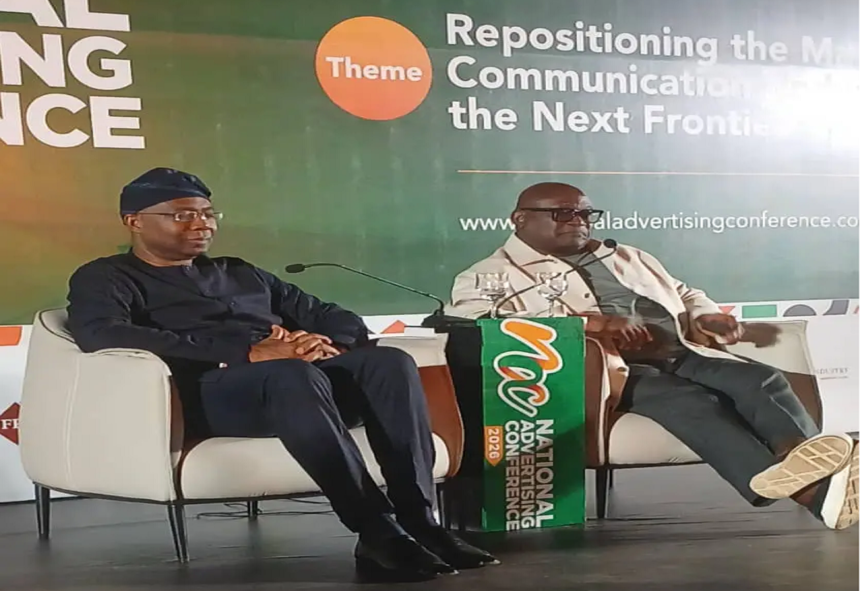
Chairman of Access Holdings Plc, Aigboje Aig-Imoukhuede, has warned that Artificial intelligence is rapidly rewriting the economics of advertising, challenging established business models and forcing agencies to rethink where and how they create value.
Speaking at the National Advertising Conference (NAC) 2026, which held in Abuja between November 11 to 13, 2026, Aig-Imoukhuede challenged industry leaders to look beyond the disruption of today and develop the foresight, knowledge and discipline required to compete in a world where technology is rapidly eroding traditional competitive advantages.
Delivering the keynote address before participating in a fireside conversation moderated by Group Chairman of SO&U, Udeme Ufot, he described the next frontier as one defined not by geography, but by the accelerating pace of technological change.
“Frontiers make people nervous because they are where the map you know ends,” he said. “If a frontier is where the map runs out, being ready means being ready to draw a new map.”

Tracing the evolution of industrial revolutions, from mechanisation and electricity to computing and the internet, Aig-Imoukhuede observed that the advertising industry was confronting another fundamental transformation before it had fully adjusted to the last.
“Just as people in this room are coming to terms with the disruption brought by the internet, there is another wahala. We have to ask ourselves big questions about what it means for advertising,” he said.
Unlike the internet, which transformed how advertising was distributed and consumed, artificial intelligence is challenging the economics of the services agencies have traditionally provided.
“Everything you knew and did well, and thought you were beginning to master after the internet’s disruption, is becoming commoditised at an extraordinary speed,” he said.
Illustrating the scale of the challenge, he suggested that advances in technology could make it possible for a small team to establish a business spanning much of the advertising value chain in a fraction of the time and at a fraction of the traditional cost.
“I could perhaps create it in three months, with two people: me and someone who understands the technology better than I do.”
However, Aig-Imoukhuede cautioned against interpreting disruption as the inevitable decline of the industry. Instead, he argued that technology would fundamentally change the sources of competitive advantage and the distribution of economic value.
“I do not think the entire advertising industry is about to be destroyed. What is about to change is who creates value, who captures value and who gets left behind.”
He also pointed to the possibility of significant growth in demand for advertising as individuals increasingly recognise the importance of promoting their skills, capabilities and personal brands.
Drawing on the experience of his daughter, who was required to produce a video as part of an application to a highly selective American school, he suggested that the ability to communicate and market oneself could become an increasingly essential life skill.
“Just as there was a point when not being able to drive was a problem, not being able to advertise yourself may become a problem,” he said.
The implication for advertising practitioners, he suggested, is that while some traditional services may lose their premium value, new markets and opportunities will emerge for those prepared to recognise and respond to them.
Turning to the importance of strategic foresight, Aig-Imoukhuede drew on his own experience in banking to illustrate how the ability to recognise emerging opportunities can shape the future of an industry.
Aig-Imoukhuede challenged the industry to apply to itself the same strategic foresight it promises its clients.
“Your sector is meant to help clients anticipate what the market will want,” he said. “To do that for them, you must first do it for yourselves.”
His message extended beyond advertising to the broader challenge facing African businesses in an increasingly interconnected and technology-driven global economy: the need to continually reassess established assumptions, develop new capabilities and recognise opportunities before they become obvious to competitors.
Drawing on the examples of football greats Cristiano Ronaldo and Lionel Messi, he challenged younger professionals to recognise that sustained excellence is built on commitment, continuous improvement and an uncompromising appetite for success.
“Ask whether you are hungry enough to beat the person in Asia, North America or Europe,” he said. “If you are not, you will not develop the discipline they have, and they will beat you.”
His challenge to the advertising industry was ultimately one of reinvention, to move beyond defending familiar ways of working, embrace the possibilities created by technological change and develop the capabilities needed to shape the next era of business.