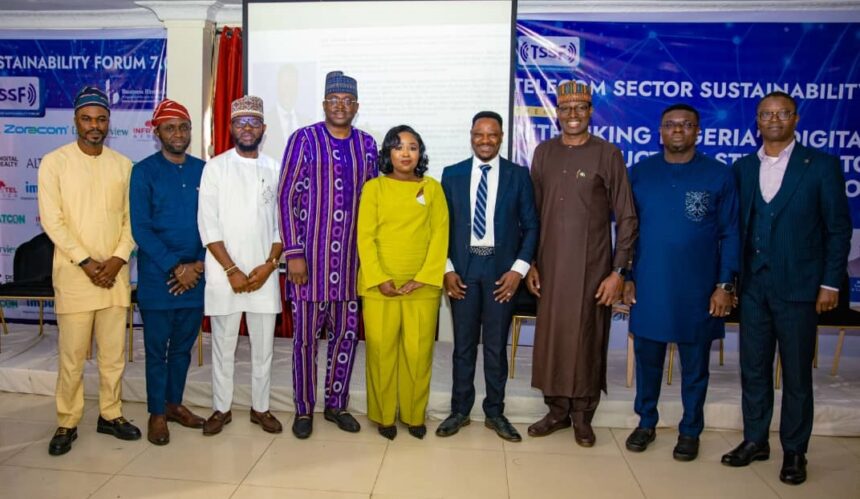
Telecommunications experts that gathered for the 7th edition of the Telecom Sector Sustainability Forum, organised by Business Remarks in Lagos, have called for a sovereign cloud policy that will not only ensure localization of data, but also guarantee the safe migration of foreign-domiciled data.
Speaking on the premise of Federal Government’s Nigeria National Sovereign Cloud Initiatives (NSCI), participants stressed on the need and gains of ensuring that, despite challenges that may arise in setting standards for hosting data generated from the country, the federal government remains resolute in insisting on compliance.
In his Keynote Presentation on “National NSCI: Enabler of Digital Infrastructure Development and Investment”, CEO of Digital Realty, and Co-Chair NSCI Technical Working Group, Engr Ike Nnamani disclosed that NSCI-TWG is setting things in place for the effective kick off of the Initiative.
Nigeria’s National Sovereign Cloud Initiative (NSCI) establishes unified rules, technical standards, and investment roadmaps to secure critical data and digital assets locally. Launched on August 5, 2026, with inauguration of the implementation Taskforce August 24, 2026, the NSCI is coordinated by the National Information Technology Development Agency (NITDA), with a target investment of $750 million in private cloud and data-centre infrastructure over 24 months. It targets to operationalize a national digital regulatory platform by October 2026.

Addressing the issue of security of data, Engr. Nnamani noted that the NSCI has several Working Groups saddled with different responsibilities of ensuring the smooth implementation of the provisions of the initiative, including the safe migration of data that are domiciled outside the shores of Nigeria.
He harped on the need for all stakeholders to contribute their quota in making the NSCI a success, noting the importance of the initiative, which will save huge amount lost in capital flight, draw foreign investment into the country, and promote the Nigeria First initiative of the federal government.
When implemented, the NSCI will draw data generated in Nigeria from global hyperscalers that include Amazon Web Services (AWS), Microsoft Azure, Google Cloud Platform (GCP), Oracle Cloud Infrastructure (OCI), and IBM Cloud, among others.
The panelists identified some major impediments to attracting investment and driving innovation in Nigeria’s digital infrastructure sector.
Chief Operating Officer, WTES Group, Chidi Ajuzie noted the prohibitive upfront taxation and levies, noting that high upfront costs for spectrum, licensing fees, and Right of Way (RoW) charges consume a substantial portion of investable capital (up to 50% of CAPEX), leaving less funding for actual network deployment and business growth.
The Chief Strategist/Executive Officer (CSEO), Zoracom Communications Limited, Dr. John Nwachukwu harped on the issue of security. He disclosed that most companies see cybersecurity as an afterthought, thereby building their infrastructure before trying to build in security. “The business case for cybersecurity investment is often overlooked, with security frequently treated as a secondary layer of infrastructure rather than a fundamental component, exposing networks to reputational damage and financial loss.”
In the words of the Founder and Chief Executive Officer of Bridge57 Solutions Limited, Mrs. Rosaline Ilori, “A big change is coming, and all players, big or small, need to identify where to play and fit in.”
While participants noted that investor trust has improved, and the industry has grown in leaps with the advantage of population size, they recognised to attend to challenges such as massive and skill and infrastructure deficit; inconsistent policies and regulatory bottlenecks; limited access to capital for smaller players; and a lack of clear commercial policies for infrastructure sharing, coupled with operators working in silos, prevents the efficient utilization of resources that discourages investment. The absence of a comprehensive national database of existing infrastructure was also highlighted.
The forum brought together key stakeholders in the Nigerian telecommunications and digital economy sector to deliberate on the theme: “Rethinking Nigeria’s Digital Infrastructure Strategy to Attract Investment and Drive Innovation.”