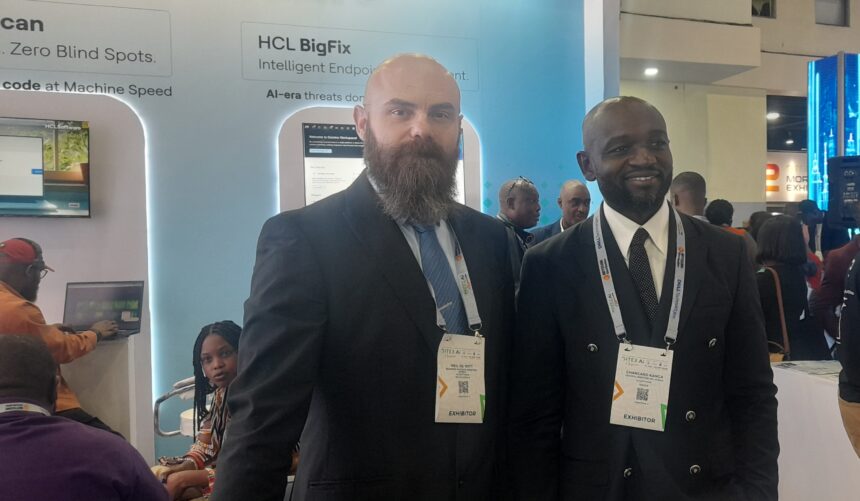
By CHIDIEBERE NWANKWO
Indian multinational, HCL Technologies Limited, has stepped in to expand its operations in the Nigerian market in its bid to bridge the growing demand for cybersecurity, endpoint management, workplace collaboration and other enterprise technology solutions in the West African region, through its software arm, HCL Software.
Speaking during an exclusive interview on the platform of the ongoing GITEX NIGERIA in Lagos, General Director, Africa, HCL Software, Chancard Moise Kanga, said the move further substantiates the company’s trust and passion for the Nigerian market, as it consolidates on its footprints in the country.
Kanga said Nigeria has emerged as one of the company’s strongest and most mature markets on the continent, accounting for a significant share of the growth HCL Software has recorded across Africa over the past three years.

Speaking on the company’s operations and strategy in Africa, Kanga described HCL as a technology group with a 50-year history that has evolved from an engineering and hardware business into a global technology and software company.
He said HCL now has about 250,000 employees, generates approximately $16 billion in annual revenue, operates in 140 countries, and maintains more than 50 offices and 19 research and development laboratories worldwide.
According to him, HCL Software’s African operations currently engage with customers and partners across 48 countries, with the company working with governments, banks, financial institutions, retailers and telecommunications companies.
Nigeria emerges as key growth market
Kanga identified Nigeria as a particularly important market for HCL Software, citing the country’s relatively advanced digital ecosystem, large technology talent pool and increasing awareness of cybersecurity and digital transformation challenges.
“We have a strong footprint in Nigeria,” he said, noting that HCL Software’s customers include leading Nigerian financial institutions.
He disclosed that the company’s solutions are deployed by many of Nigeria’s leading banks, particularly for intelligent endpoint management and patch management.
Beyond Nigeria, Kanga said HCL Software also works with several government institutions across West Africa, particularly in areas involving digital workplaces, collaboration, email, project management and data sovereignty.
He attributed the strong growth in Nigeria to the country’s digital maturity compared with several other markets in the region. “Nigeria is a strong and mature market with a lot of people. They understand what the digital challenges are,” he said.
He contrasted Nigeria’s technology ecosystem with markets such as Mali, Senegal and Côte d’Ivoire, pointing to the country’s growing adoption of cloud services, artificial intelligence applications, locally developed platforms and digital payment systems.
Kanga said HCL Software’s artificial intelligence strategy is not based primarily on selling standalone AI products, but on embedding AI capabilities across its software portfolio.
HCL tech acquired IBM software arm in 2019 and has since grown the HCL Software brand to offer key solutions.
Kanga noted that HCL Software has a portfolio of about 89 software solutions, although adoption varies significantly from one market to another depending on local digital maturity and business priorities.
In Nigeria, he said, demand is particularly strong for intelligent operations, cybersecurity, workplace and customer-experience solutions, including BigFix, AppScan, HCL service-management technologies and HCL Domino.