Founder/Chief Executive Officer of New Horizons Nigeria, Mr. Tim Akano, has challenged women entrepreneurs and executives to move beyond using artificial intelligence (AI) tools to building and owning technology companies, platforms and intellectual property that will shape the global economy.
Akano, who delivered the keynote address at the Women Entrepreneurs & Executives in Tech Summit & Awards (WEETS) 2026, themed “From Innovation to Impact: Women Leading the AI-Driven Future,” warned that women risk being excluded from the emerging distribution of economic power if they fail to position themselves for ownership in the AI economy.
“I stand before you not to flatter, but to sound an alarm dressed as an invitation,” he declared, stressing that the window for women to secure a meaningful stake in the technological revolution was closing faster than previous economic transformations.
He argued that the AI revolution was creating new opportunities for wealth creation, entrepreneurship and influence, but warned that technological progress does not automatically guarantee equal participation.

“The question is not whether the revolution will happen; it has already happened. The question is who will own a piece of it?” he said.
Akano traced previous technological revolutions, from the discovery of fire and the Agrarian Revolution to industrialisation and the information and communications technology revolution, noting that each created new economic power structures.
He said artificial intelligence could trigger one of the greatest redistributions of economic power in human history, making it imperative for women to move beyond participation as employees and consumers.
Citing figures from Forbes’ 2026 billionaire list, Akano said women accounted for 481 of the world’s 3,428 billionaires, representing about 14 per cent.
He also referenced the 2026 Fortune Global 500, where women occupied only 34 chief executive positions, representing 6.8 per cent.
According to him, the gender imbalance is also evident in AI, with LinkedIn research cited in his presentation showing that women accounted for only 26 per cent of US hires into AI roles in 2025, compared with 50 per cent in non-AI occupations.
He warned that women’s limited presence in AI leadership could affect their influence over systems increasingly shaping business, healthcare, finance, education and government.
“If women are absent from the architecture of that infrastructure, then women will have less influence over the world that infrastructure creates,” he said.
The New Horizons CEO, however, urged women not to view AI primarily as a job-killing technology, citing World Economic Forum estimates that labour market transformation could create 170 million jobs and displace 92 million by 2030.
He said the challenge was to acquire skills that would remain valuable as work evolves, identifying AI, big data, cybersecurity and technological literacy alongside creativity, resilience, leadership and lifelong learning.
Akano maintained that combining professional expertise with AI proficiency would give women greater capacity to innovate and compete.
“AI is not necessarily coming for women. AI is coming for tasks,” he said, urging women to embrace AI fluency, ownership and leadership rather than fear.
He outlined four levels of participation in the AI economy: user, operator, builder and owner, challenging women to progress from using AI tools to developing products and owning companies, datasets, platforms and intellectual property.
“Use AI, Understand AI, Build with AI, then: Own what you build,” he charged, adding that “employment gives you income. Ownership gives you leverage.”
Turning to Africa, Akano highlighted the estimated $49 billion financing gap confronting women entrepreneurs, describing it as a broader economic challenge that limits the continent’s productive capacity.
He argued that financing must be connected to technology, markets and intellectual property to help women-led businesses scale beyond survival.
“Africa does not have a shortage of entrepreneurial women. Africa has a shortage of systems that turn women’s ideas into scalable assets,” he said.
Akano also identified African data as a major opportunity for women entrepreneurs, noting that information on the continent’s healthcare, agriculture, languages, consumers and financial behaviour remains incomplete or poorly represented.
He urged women to identify underserved problems and build AI solutions around them, arguing that the next major African AI company could emerge from specialised knowledge of a local challenge rather than another general-purpose chatbot.
The keynote speaker outlined five priorities for women: learning the language of data, securing seats in AI decision-making, building technology startups, financing women-led ventures and encouraging girls to pursue mathematics, engineering, robotics and AI.
He further challenged participants to implement a 12-month action plan: learn an AI tool, redesign an organisational process using AI, build an AI-powered product or prototype, mentor a younger woman and support at least one woman-led technology venture.
“Ecosystems are not built by speeches but by people helping other people move,” he said.
Akano concluded by urging women to stop merely seeking inclusion in existing power structures and instead create their own companies, platforms, investment networks and technologies.
“For too long, women have been told: ‘Ask for a seat at the table.’ I want to go further. Build your own table,” he said.
He urged African women to become architects and owners of the AI-driven future, declaring: “Do not merely use the future. Own a piece of it.”
Earlier in her welcome address, event convener, Ugochi Emmanuel described WEETS as more than an annual event, calling it a growing movement that connects women across sectors to learn, collaborate and drive impact.
She said this year’s theme reflects the scale of disruption AI is bringing to work, business and everyday life, and stressed that women should not merely use these technologies but help build and lead them.
Emmanuel highlighted the summit’s ongoing Advanced Digital Skills Bootcamp, which has trained young girls and women in areas including artificial intelligence, cybersecurity, web development, digital entrepreneurship and content creation.
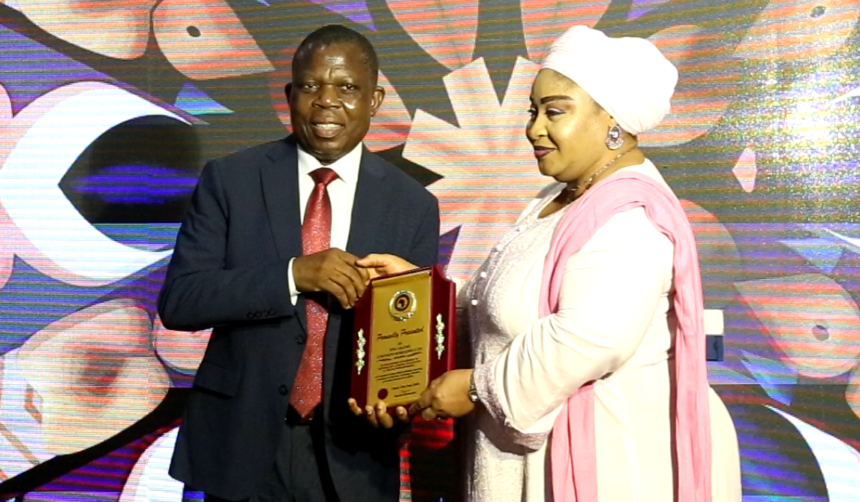
She singled out CEO of New Horizons, Tim Akano, for hosting the two-day bootcamp free of charge, calling it a vote of confidence in the programme’s mission.
She also thanked a long list of sponsors and partners, including Digital Encode, Moniepoint, Quomodo Systems, Medallion Data Centres, IXPN, the Nigerian Communications Commission, VDT Communications, Image Expressions, the Nigeria Data Protection Commission, Internet Connectivity Solutions Limited (ICSL), Infratel Africa and the Nigeria Internet Registration Association (NiRA), alongside the event’s production crew and volunteer network.
According to Emmanuel, this year’s summit reflects the breadth of industries now touched by technology, with women in attendance representing tech, finance, maritime, tourism, culture, media and entrepreneurship, underscoring the organisers’ push for broader digital inclusion.
Looking ahead, Emmanuel outlined plans to expand the initiative’s reach, including training more women, distributing laptops and other digital tools, and expanding mentorship and business-support opportunities.
She called on corporate organisations, government agencies, development partners and philanthropists to back the vision with funding, technical support and technology resources.
She closed her address with a call to action for women in the room to embrace innovation and leadership without hesitation, urging them to “learn, connect, collaborate, innovate” and turn that innovation into lasting impact.