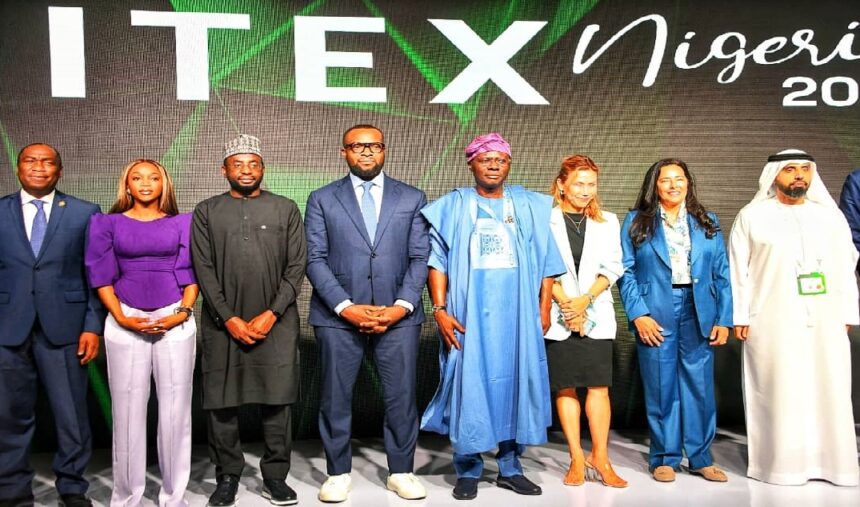
… As GITEX Nigeria Exposes The Country To Growth Opportunities
Following the successful initiation of the TETFund National Research Fund (NRF) that saw the Federal Government approving N4.2 billion for 158 research projects, the Minister of Communications, Innovation and Digital Economy, Dr. ‘Bosun Tijani has announced the NITDA Digital Research Support.
The NITDA Digital Research Support, which will be formally announced in October 1, 2025, will see the FG funding 75 new research projects to deepen Nigeria’s digital ecosystem, through the National Information Technology Development Agency (NITDA).
Making this revelation in Lagos at the opening day of the Gulf Information Technology Exhibition (GITEX) Nigeria Expo Lagos, the Minister acknowledged that Nigeria has embraced the digital economy as a key driver of inclusive growth.

The scheme is aimed at researchers, startups, corporates, and the Nigerian diaspora, with a goal geared at building a resilient ecosystem and positioning Nigeria as a hub for innovation in Africa.
He further stressed on the import of the research project: “It means empowering the private sector to lead through initiatives like the AI collective, where Nigerian companies are building real world solutions with artificial intelligence, and it means deepening the participation of our diaspora some of the brightest Nigerian minds shaping technology across the globe to bring their capital, their expertise and their networks back home. This is how we believe we should build, and are building not just projects, but a resilient, innovative and globally connected ecosystem, one that ensures that Nigeria is not only keeping pace with the digital future, but also checking it as well.”
Dr. Tijani highlighted the need for collaboration, stating: “Government investment, we’re very sure alone, cannot deliver the data transformation that we seek. Ours is to build the foundation through our fiber network initiative, through the talent pipeline program, through digital public infrastructure, but also forward linking legislation with the sole purpose of enabling the ecosystem, the opportunity and the responsibility now lies with all of us.”
“We’re offering a transparent and accelerated path to collaboration, investment and co creation with Nigeria,” he said.
In his remark, Director General, National Information Technology Development Agency (NITDA), Kashifu Inuwa spoke of the successes and tech exploits Nigeria had recorded. “In other places, they use capital infrastructure to fuel innovation, while here we use our resilience because we have no options. We need to create the solutions. So we’ve been building unicorns in Nigeria. Out of eight or nine unicorns in Africa, five originated from Nigeria and this shows that it didn’t just happen by accident. It was intentional. There was a policy from government that led to that to happen, and that mean our potential is not only around fintech.”
He pointed to the importance of economic diversification and inclusivity as emboldened by Mr. President at assumption of office. “We have done it in the fintech. We are going to do it in agritech. We are going to do it in security, we are going to do it in health, we are going to do it in any critical sectors we have. Our vision is clear, our journey is set, and our resolve is stronger than even.”
Speaking on the potentials in Africa, Regional Director, Central Africa & Anglophone West Africa, IFC, Dahlia Khalifa, said Africa’s digital economy has been one of the fastest growing in the world, as it is quickly becoming a center of attraction by 2030, projected to contribute to about $180 billion to Africa’s GDP.
“It shows that the digital transformation here could benefit over 600,000 formal businesses and 40 million micro enterprises, boosting productivity, raising wages and creating better quality jobs and livelihoods for all, this is why the role of the private sector and public private dialog is decisive.”
She further pointed to the instruments that would help achieve the set goals: “Infrastructure is the foundation, but entrepreneurship is the engine, as we can see outside these doors, and the landmark to seize this opportunity, we need reliable broadband, robust data centers, modern digital infrastructure and more energy, particularly re clean energy, so that it can be sustainable. We need investment in skills and training programs that prepare Africa’s youths for the jobs of today and tomorrow, and we need partnerships between governments the private sector and international institutions to create the right policies, foster trust and mobilize capital at scale. At IFC, we are committed to this and to helping in this unlocking of the future.”
Looking at the future Khalifa noted that Africa, will be quantum leapfrogging by harnessing AI and digital technology responsibly and by building the right partnerships. “Africa can shape a digital economy that is inclusive, innovative and globally competitive, one that enables a global economy to be reachable locally, and a local economy that can go global, and one where local opportunities serve the needs of local communities. That is the future that AI can enable in Africa, and that is why we are all here today.”
According to the EVP-Dubai World Trade Center/ CEO, KAOUN International, Trixie LohMirmand, by hosting GITEX in Nigeria, the organisers are turning the world towards Nigeria. “This is what it means. Look at the economic impact. You’re here for the first time. I want to thank you sincerely for braving it. This is a maximum baptism of fire, judging by this morning. I don’t care what’s going to happen the next two days, you’ve done it.”