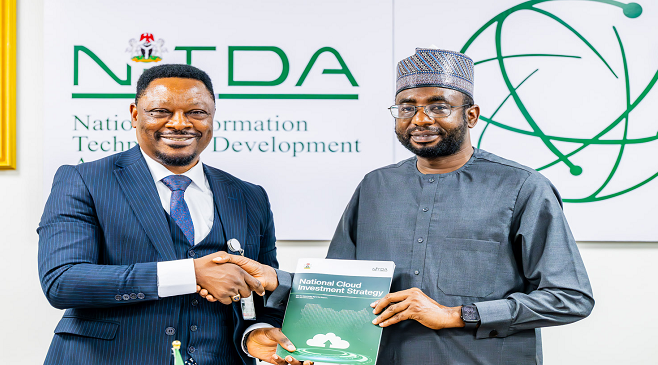
The National Information Technology Development Agency (NITDA) formally unveiled and signed key regulatory instruments for the National Sovereign Cloud Initiative (NSCI) in Abuja on Tuesday August 4, 2026. The framework features three core instruments—the National Cloud Computing Guideline, the National Cloud Technical Guideline, and the National Digital Infrastructure Assurance Framework (NDIAF)—alongside the National Cloud Investment Strategy.
Under the NSCI, the National Cloud Computing Guideline sets the foundational rules for public and private cloud adoption; the National Cloud Technical Guideline establishes unified technical standards for data classification, security, and risk management; the National Digital Infrastructure Assurance Framework (NDIAF) provides the mechanism for auditing and certifying digital operators; while the National Cloud Investment Strategy focuses on attracting hyperscalers and Big Tech to build local hyperscale data centers.
The NSCI is a strategic programme of the Federal Government, coordinated by NITDA, designed to bolster Nigeria’s digital sovereignty and accelerate the West African country’s adoption of reliable cloud infrastructure.
NITDA disclosed the initiative, part of efforts at strengthening Nigeria’s digital sovereignty and digital economy, consists of the National Computing Guideline, the National Cloud Technical Guideline, the National Digital Infrastructure Assurance Framework, and the National Cloud Investment Strategy.

Speaking during the ceremony in Abuja, Director-General of NITDA, Malam Kashifu Inuwa Abdullahi, described the NSCI as a strategic move to safeguard Nigeria’s digital future.
Inuwa noted that the instruments would stimulate innovation, encourage investment in local cloud services, and enhance digital resilience.
He also said: “These instruments provide the regulatory certainty, technical standards, and assurance framework required to build a trusted cloud ecosystem that safeguards Nigeria’s digital sovereignty while creating new opportunities for investment, innovation, and sustainable economic growth.
“We should position ourselves not to serve Nigeria alone, but to serve West and Central Africa. Nigeria is already the digital gateway to West Africa and can extend to every part of Africa. But we can only realise that goal when we build our infrastructure. So, today’s event is the first step in that direction.”
The DG appreciated the support of relevant stakeholders and the efforts of the NSCI Technical Working Group, which culminated in the successful development of the regulatory instruments.
He equally emphasised that collective action of regulatory agencies is necessary for a seamless implementation of the initiative.
Earlier, Permanent Secretary of the Ministry of Communications, Innovation, and Digital Economy, Engr. Nadungu Gagare, had said that the launch of the NSCI underscores the Federal Government’s commitment to safeguarding Nigeria’s data borders and digital economy.
Gagare stated: “By ensuring that government data remains strictly within national jurisdiction and under local operational control, we are guaranteeing data sovereignty and regulatory compliance. It will catalyse local cloud capacity, foster local job creation, and empower indigenous investors and innovators to build solutions on a secure, locally hosted foundation.”
He promised that the Ministry would ensure that the strategic objectives of the NSCI are fully realised across all ministries, departments, and agencies.
In a message, Governor of the Central Bank of Nigeria (CBN), Dr. Olayemi Cardoso, congratulated NITDA for promoting a collaborative approach.
Cardoso stressed that modern digital regulation succeeds through coordinated regulatory actions for common national objectives.
The CBN Governor, represented by the Director of the Payment System Supervision Department at the Bank, Dr. Rakiya Opemi Yusuf, acknowledged that the launch testifies to the robust collaboration existing between the apex bank and other government institutions.
He stated: “CBN regulates the financial ecosystem. NITDA provides the national framework for digital infrastructure, cloud governance and assurance.
“These responsibilities are complementary, not competing. Together, they create a coherent national architecture.”
Cardoso noted: “Together with NITDA, and with the continued cooperation of industry, we will continue to build an ecosystem that protects Nigeria’s financial system today and positions our nation as Africa’s trusted hub for digital finance and cloud innovation.
“One of the most encouraging aspects of today’s event is the strong institutional collaboration between NITDA, the CBN, and other relevant government institutions. This collaboration demonstrates an important principle.”
The CBN Chief as well reiterated that as a responsive regulator, the CBN remains committed to providing clear expectations, firm principles, proportionate implementation, and constructive engagement with all stakeholders to position Nigeria as Africa’s trusted hub for digital finance and cloud innovation.
The Managing Director/CEO of Galaxy Backbone Limited, Prof. Ibrahim Adeyanju, also observed that the NSCI couldn’t have come at a better time than now, especially considering CBN’s recent directive mandating banks and financial institutions to localise their data.
Adeyanju expressed confidence that the initiative would push the ecosystem to greater heights by encouraging investment, developing indigenous talent, and creating employment opportunities akin to the gains brought by the deregulation of the telecoms sector.
NITDA, therefore, assured the stakeholders that it would constitute the Sovereign Cloud Governance Committee (SovGov) within the next two weeks to oversee the implementation of the NSCI.
The Committee would comprise representatives from relevant Government institutions, sector regulators, industry, and the private sector, with NITDA serving as the Secretariat, said the agency.