… NCC To Sustain Reforms Investment, Infrastructure, Tariff
Stakeholders that gathered for the Nigeria Digital Connectivity Investment Forum 2026 have, among other charges, called on the Federal Government to accelerate the delivery of Project BRIDGE, the 90,000 km national fibre backbone, as a strategic response to the middle-mile connectivity gap.
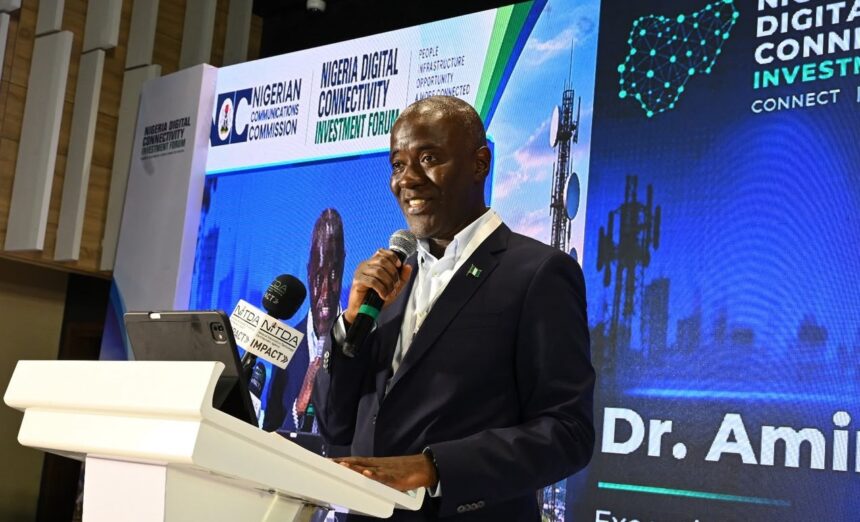
The 2-day Forum, held last week in Abuja, was convened by the Nigerian Communications Commission (NCC), in partnership with Swedfund and Ookla, with its theme as “Unlocking Infrastructure Investment through Data, Transparency and Partnerships”.
The Forum, which provided a platform for government, regulators, investors, financiers, infrastructure providers and other stakeholders to examine Nigeria’s digital infrastructure investment opportunities, identify barriers to deployment and financing, and agree practical actions for accelerating investment and expanding meaningful connectivity, was attended by the Minister of Industry, Trade and Investment; representative of the Minister of Communications, Innovation and Digital Economy; and the Ambassador of Sweden to Nigeria. Other attendees included heads of Federal agencies; development finance institutions, investment banks and institutional investors; mobile network operators, tower and fibre infrastructure companies, satellite and fixed wireless providers; original equipment manufacturers (OEMs); industry associations; and Management and staff of the NCC.

The forum highlighted important drivers to be noted. They include that:
- Power and the middle mile are the binding constraints on deployment: For tower companies’ power is not a side business but the business, and the cost of inland connectivity confines datacentre and internet service investment to a few metropolitan centres. Energy and connectivity investment should be planned together, with tower clusters recognised as anchor off takers for distributed generation.
- Long-life assets require long-tenor capital: Digital infrastructure has an asset life of twenty to thirty years and cannot be financed on five-year bank tenors. Infrastructure financing in Nigeria has grown from under ₦70 billion in 2004 to ₦19.4 trillion in 2025, and access to that capital rests on governance, management capacity and predictability. Long-term financing is not, however, automatic bankability.
- State-level conditions determine the pace of deployment: The pilot of the Nigeria Digital Connectivity Index across twelve States shows Right of Way reform translating directly into fibre growth of between 22% and 95% in reforming States, with twelve States now charging zero, up from seven in December 2024.
- New deployment models are available now: Shared rural networks, satellite services delivered to unmodified handsets, micro-cabling, solar-powered rural sites and local device and SIM manufacturing all reduce the cost of reaching the unserved. None removes the need for affordable devices in user’s hands.
The stakeholders further encouraged the NCC to sustain the reforms already improving investment conditions, including the tariff realignment, the designation of critical national information infrastructure and Right of Way engagement with States; publish the first national Nigeria Digital Connectivity Index report; advance open-access and wholesale regulation; and finalise the direct-to-device framework.
State Governments were also charged to cut and harmonise Right of Way (R0w) and site permit charges, adopt the Federal model under which the operator that lays fibre reinstates the road, and shorten permitting timelines.
While operators, infrastructure and technology companies were urged to pursue shared-infrastructure and neutral-host models that lower the cost of rural and indoor coverage, and pair every coverage investment with measures that put affordable devices in users’ hands, including locally manufactured devices and SIMs, investors and development finance institutions were told to match long-life assets with long-tenor naira capital, tying infrastructure funding to independently verified network performance, and use blended structures and credit enhancement to bring projects that are not yet commercially ready to market.
The roundtable discussion laid a blueprint for the industry. The participants agreed the following priority actions, with the period within which each should be taken:
Within six months:
- Secure funding for community co-owned rural networks powered by renewable energy in zero-connectivity communities, through partnership with the Universal Service Provision Fund, State governments and the Rural Electrification Agency.
Within six to eighteen months:
- Issue open-access and wholesale regulation, publish a wholesale rate card and complete the broadband mapping.
- Give the Universal Service Fund regulatory backing as the primary source for underserved-area projects, supported by blended public and multilateral funding.
- Build the business case for indoor coverage in commercial buildings, with tower companies, neutral hosts and property owners.
- Capture data-centre requirements in the National Broadband Plan, pairing off-grid and renewable power with blended finance.
Within eighteen to twenty-four months:
- Establish a financing framework for telecommunications power, standardising energy provision by regulation and bringing it within critical national information infrastructure protection.
- Develop metro and access fibre under concession, mapped against existing assets and integrated with Project BRIDGE.